THE ARCHIVE BEGINS
What I found in London, Paris, Provence, and Bath — and what found me.
MELROSE HOME & CO. · JULY 2026 · 12 MIN READ
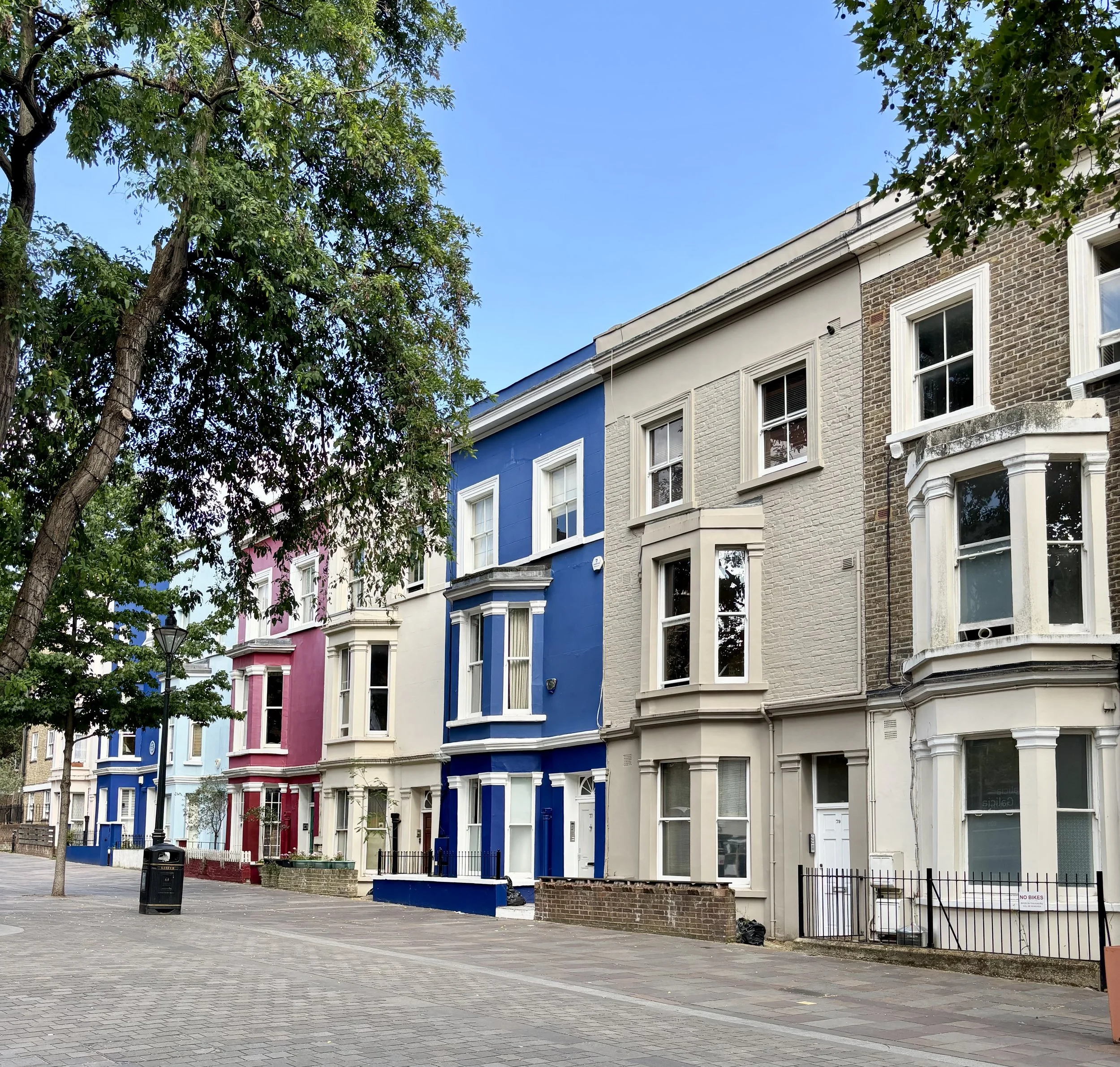
Notting Hill, London.
"Everything I was looking for, I didn't find.
Everything I needed, I did."
I went to Europe to source for The Archive. Twenty days, four places, and a very specific goal: find original art and objects worth bringing home. What I actually came back with was something harder to put on a shelf — but more useful in the long run.
Here's what the trip looked like.
CHAPTER ONE
London,
Part One
My first stay was in Shoreditch — street art everywhere, Victorian buildings next to glass towers, great food around every corner. I had dinner at Gloria and honestly it was one of the best meals of the trip. Haggerston, right around the corner, was quieter — more residential, more artsy in that low-key way where nobody's trying too hard. I liked both neighborhoods immediately.
The first couple of days I just walked. Explored. Let myself settle in before I started looking for anything.
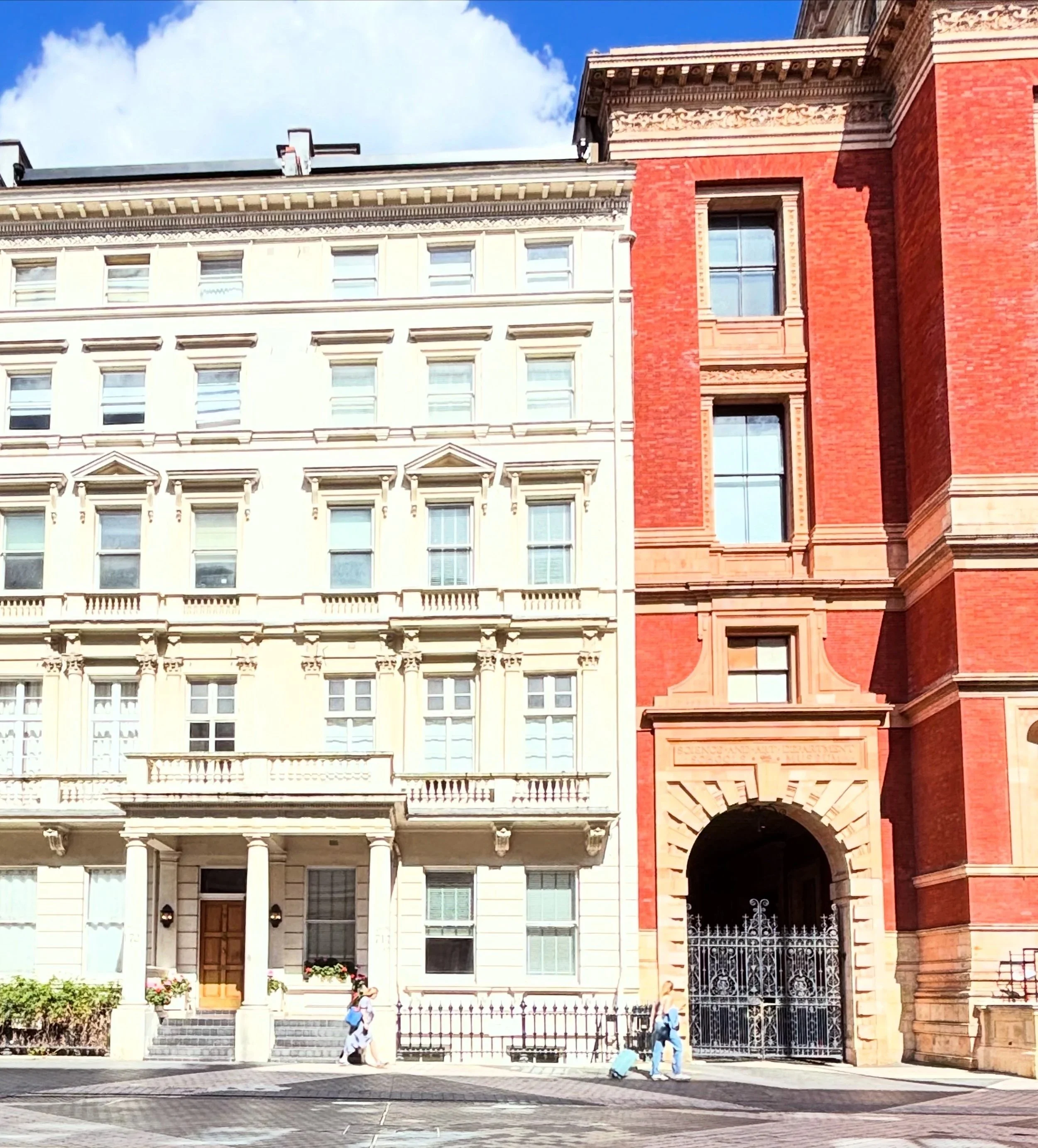
South Kensington, London — where centuries of architecture have learned to coexist.
One afternoon I went up to The Shard — the whole city just makes sense from up there. You can see how everything connects. I had afternoon tea 32 floors above London, which was exactly as beautiful as it sounds. And later that night I saw Bad Bunny live at the Tottenham Hotspur Stadium, which — yes, that's in the blog — because some experiences remind you that the best spaces are the ones designed to make people feel something together. That counts in design too.
Notting Hill & Portobello Road
Notting Hill lived up to everything. The pastel-painted Victorian terraces — powder blue, coral pink, warm yellow — every house fully committed to its own color. It should feel chaotic and it doesn't. Walking through it feels like someone curated a neighborhood and got it exactly right.
I walked for a while before I even started looking at shops. Some places need to be experienced before they're used.
Portobello Road was everything I expected and also nothing like I expected. Vendors from everywhere, objects covering every surface — antique silverware next to vintage clothing next to original paintings next to things you couldn't immediately identify. The energy of the place is unlike anything. Everyone looking for something they can't quite name.
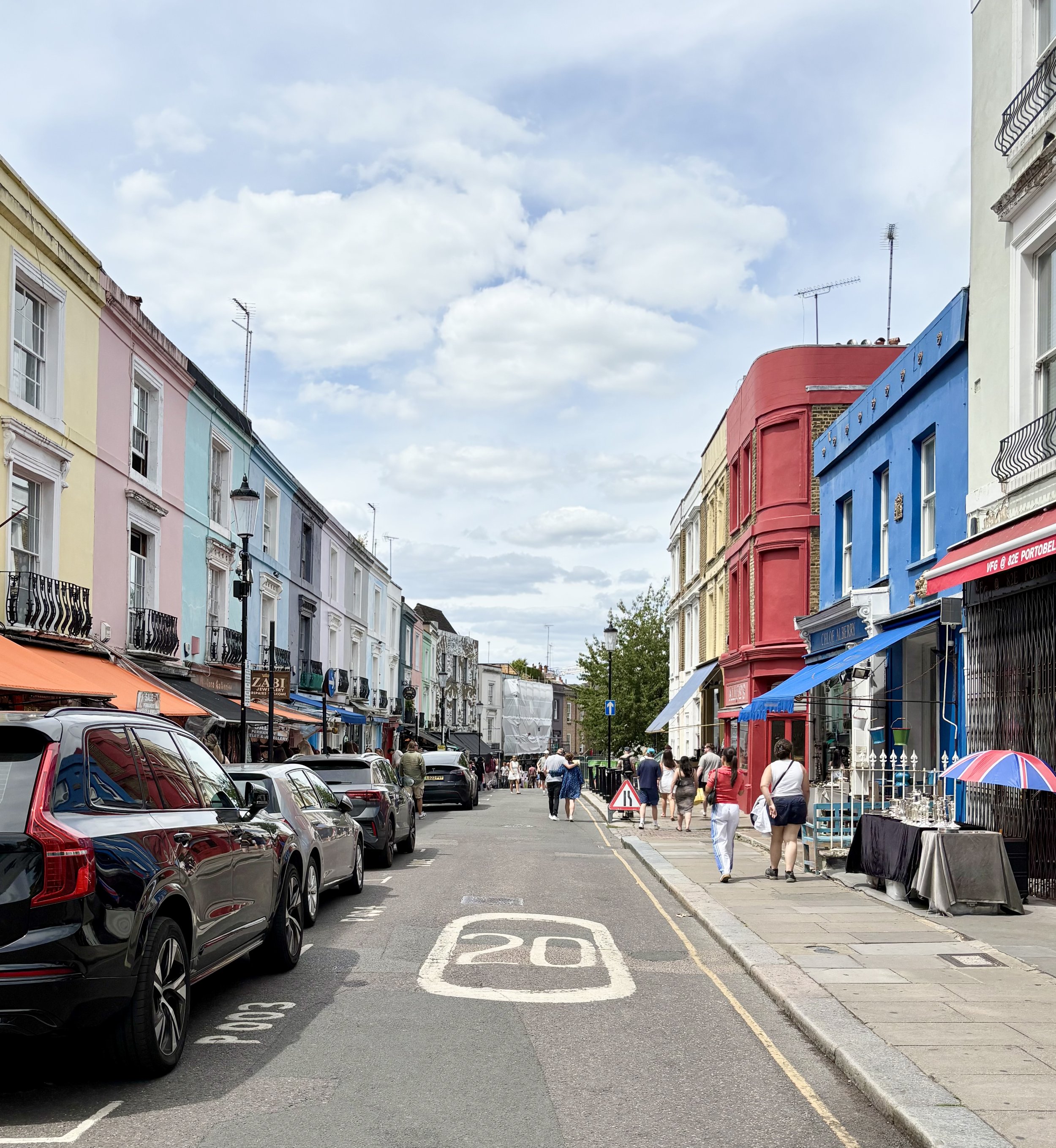
Portobello Road — where everyone is looking for something they can't quite name.
I didn't bring much home from Portobello. I found some vintage Burberry for myself, but the right pieces at the right price point for where The Archive is right now — they weren't there that day. But I left with something more useful: contacts. Vendors who understood what I was building and want to be part of it. A clearer picture of what the Archive is and what it isn't ready for yet. The search was the point, and the search was good.
The Museums
Museum day was a lot — in the best way.
I started at the Museum of the Home, about 15 minutes from my hotel. I almost skipped it. I'm really glad I didn't.
It's a two-story museum that recreates rooms from different eras — not grand royal rooms, but the actual rooms where regular people lived. A parlour in 1695. A living room from the 1960s. Each one a reminder that a home isn't just a backdrop — it's where a life actually happens. That hit differently than I expected.
"A home isn’t just a backdrop — it's where a life actually happens "
From there I went to the V&A — which is just a completely different thing. Room after room of art, furniture, ceramics, textiles, design objects across every century and continent you can think of. The building itself is extraordinary. In the central courtyard I stopped for afternoon tea on the grass while kids dipped their feet in the reflecting pool. It was one of those moments where you think — this is why people come to London.
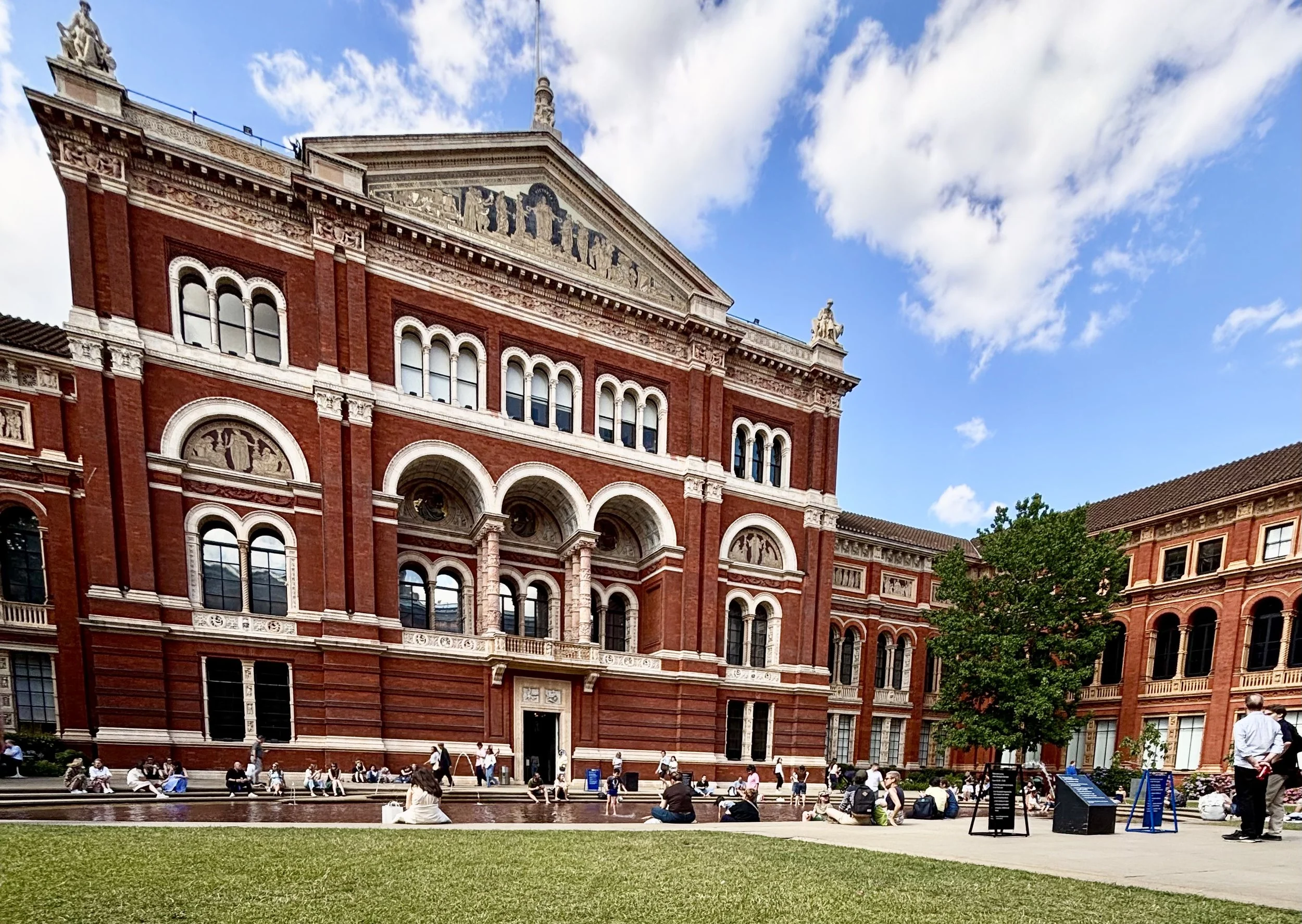
The Victoria and Albert Museum — where the building itself is part of the collection.
I ended the day walking through South Kensington — past the Royal Albert Hall, through Kensington Gardens. A good way to close it out.
Simone Brewster & the Design Museum
The next day I went to the Design Museum. And on the second floor, I found something I didn't know I was looking for.
An exhibition by Simone Brewster. She works across architecture, jewellery, painting, and furniture — not as separate things but as one continuous practice. She calls it an architecture of intimacy. The idea that objects carry stories, that they bridge memory and experience, that the spaces we build can hold both belonging and something spiritual.
I stood there for a long time. Not just because it was beautiful — because it said something I've always felt about design but never had the words for. The things we surround ourselves with aren't just decorative. They're expressive. They reflect who we are, what we've been through, what we hope for.
"The things we surround ourselves with aren’t just decorative.
They are expressive."
That's the whole reason The Archive exists. That's why every piece I choose has to mean something beyond how it photographs. Simone Brewster gave language to something I'd only ever felt. That's a rare thing.
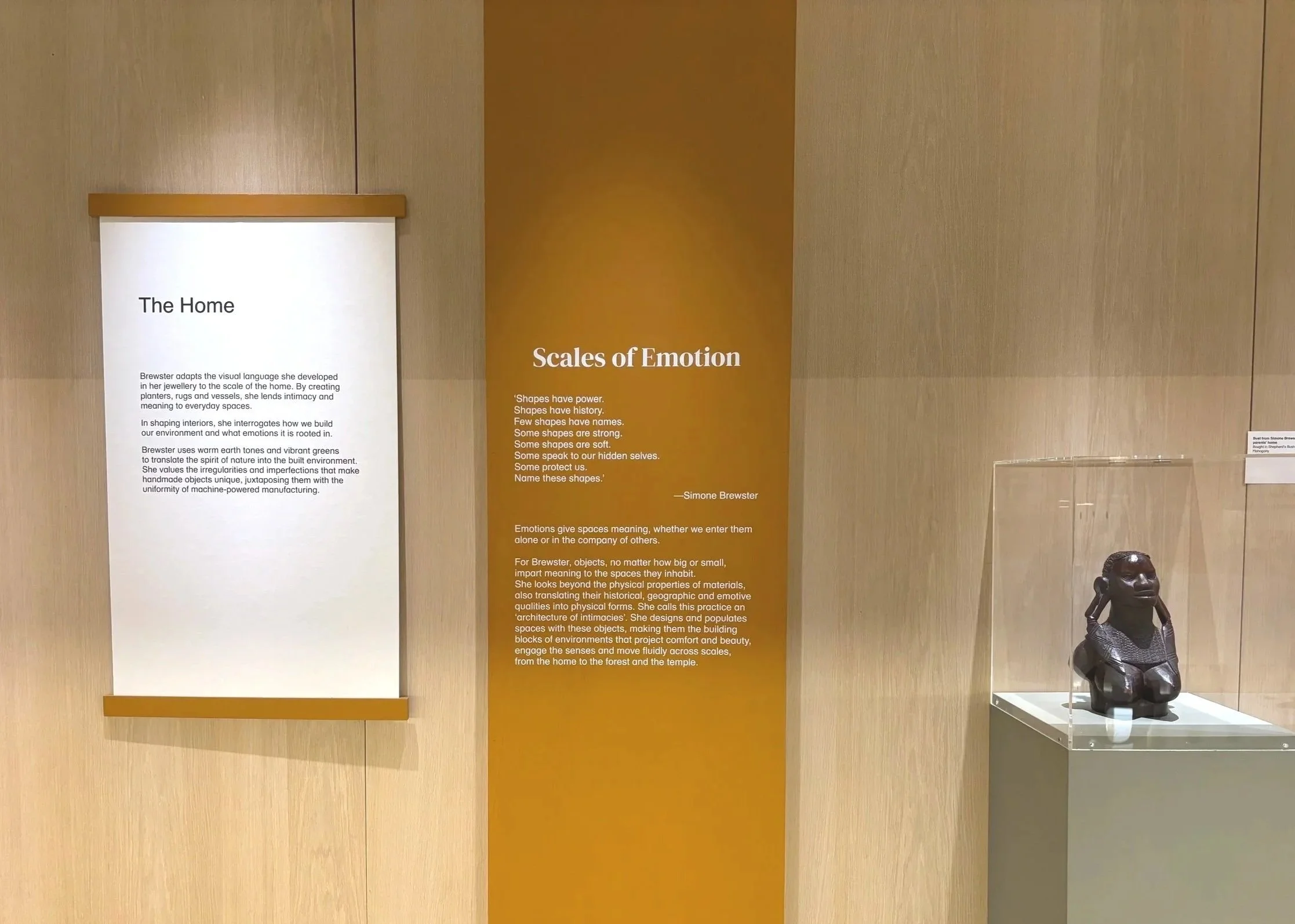
The Design Museum, London — and the exhibition that put language to something I had only ever felt.
London gave me what it was supposed to — not a haul, but an education. The contacts from Portobello are in my phone. And Simone Brewster's work is now part of how I talk about design.
CHAPTER TWO
Paris
I've been to Paris before, but never in summer. Summer Paris is a completely different city.
Everything slows down and opens up at the same time. The cafés spill out onto the sidewalks. The Luxembourg Garden fills with people who have nowhere they need to be. And the Eiffel Tower lights up at night over a lawn of strangers sharing wine and speaking every language — and you realize you're never actually over it. Every time.
Paris in summer doesn't let you be cool about Paris.
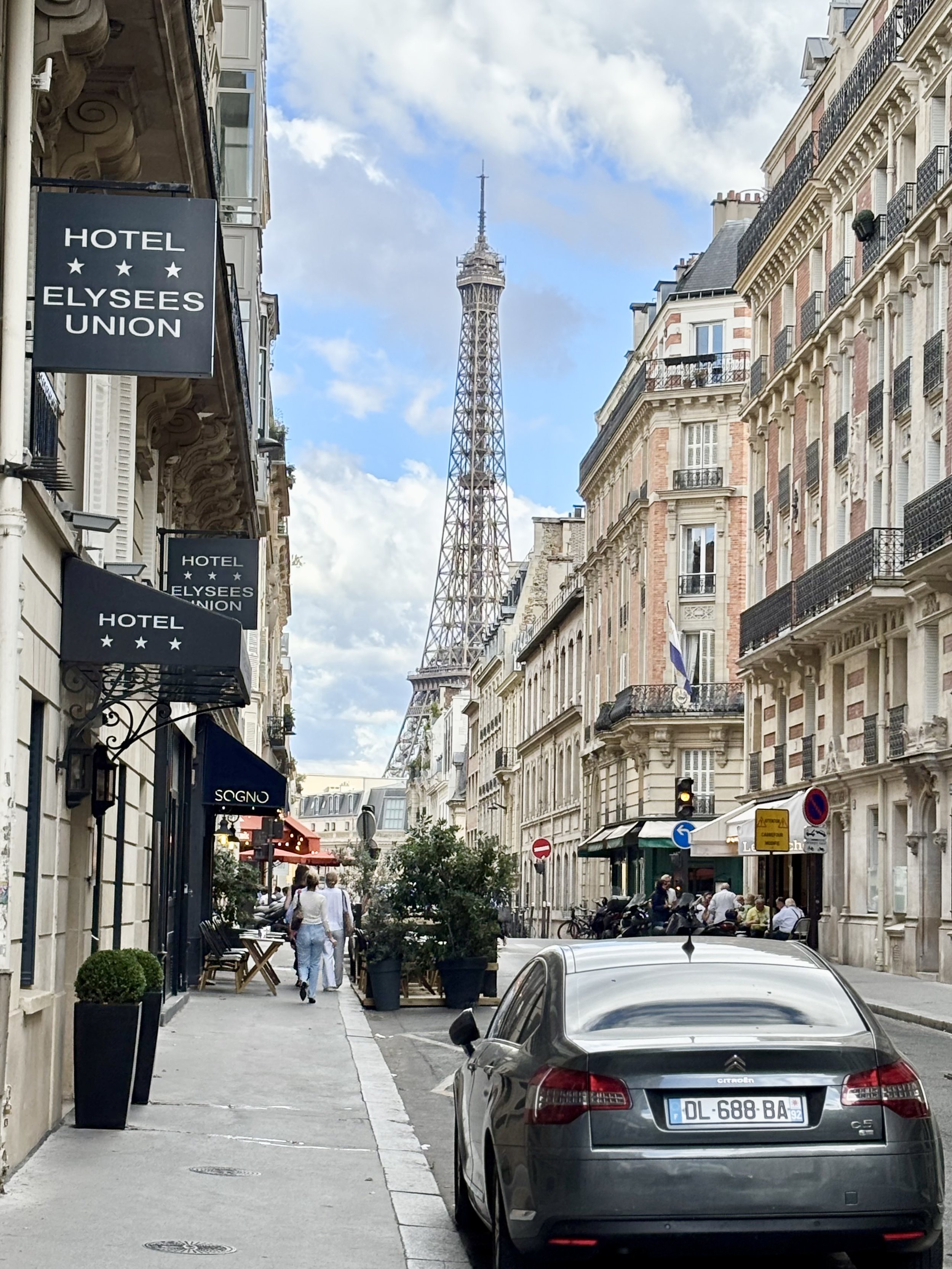
Paris in summer doesn’t let you be cool about Paris.
Paul Bert
I spent an entire day at the Paul Bert Serpette market — and it was the day The Archive became real.
Paul Bert is nothing like Portobello. Where Portobello has that fun, carnival energy, Paul Bert is serious. The vendors are dealers — people who've spent careers knowing exactly what they have. Narrow aisles, dense with objects, and conversations that go long if you let them. I let them.
I found 19th and 20th century paintings that stopped me in the best way — not because they were the most impressive things there, but because I already knew the walls they were going to live on. Some of them are going on mine. A few will be the first pieces The Archive ever offers.
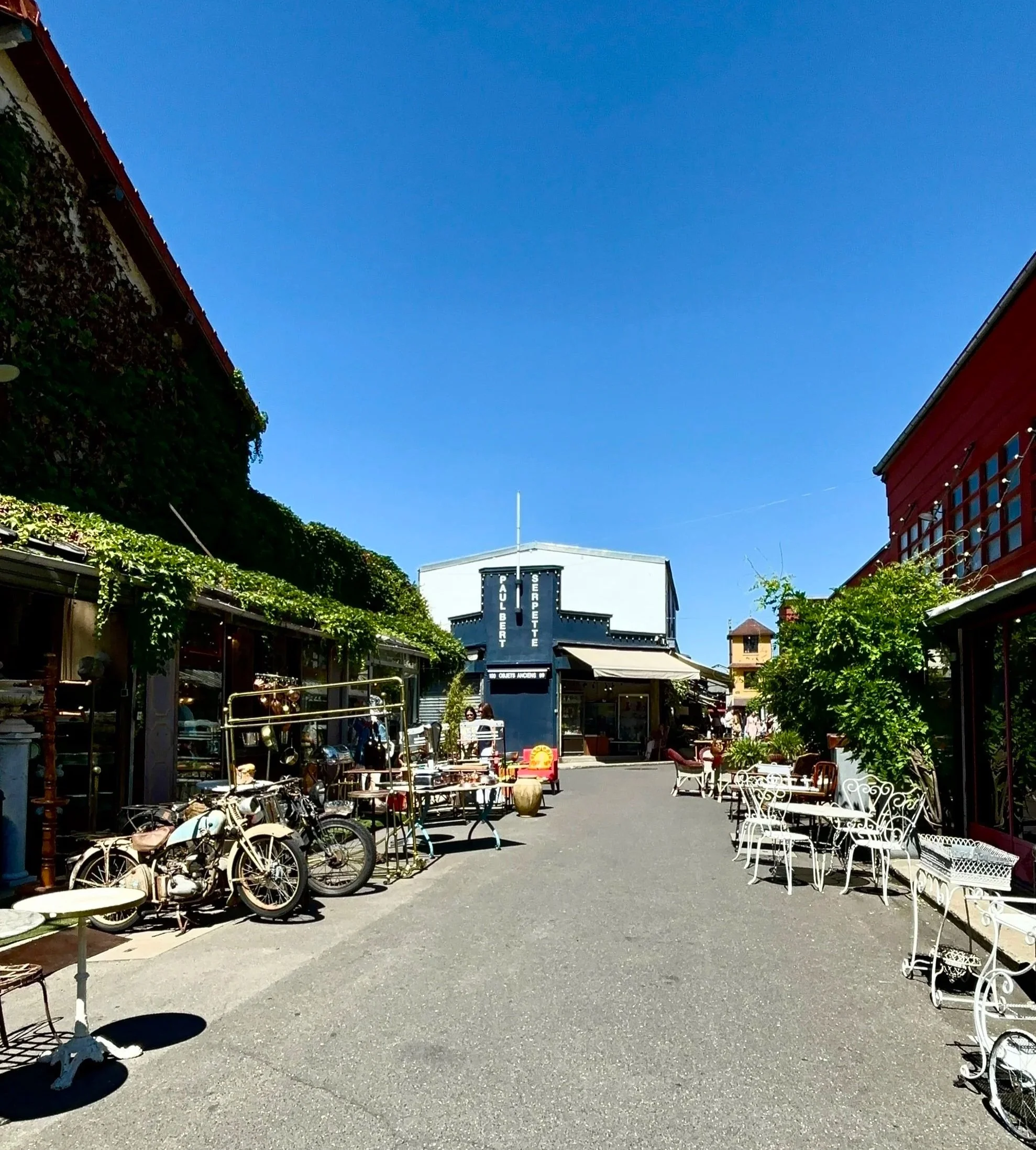
The Paul Bert Serpette market — where The Archive found its first pieces.
I also left with a network. Dealers who get what I'm building, vendors willing to ship to the US, and a Philadelphia-based dealer with a warehouse full of European finds who I'll definitely be working with as the Archive grows.
I came to Paris looking for pieces. I left with the foundation of something bigger.
Living Like a Local
Between markets, I did what Paris basically demands of you — I slowed down.
I walked the Haussmann boulevards, sat in the Luxembourg Garden at golden hour, watched the Carnaval on the Champs-Élysées. Paris knows how to celebrate itself and it's impossible not to get swept up in it.
One afternoon I went up to Sacré-Cœur. From the steps, you can see the whole city laid out below you. Inside, I lit a candle for people who are no longer with me. Some moments on a trip have nothing to do with design or sourcing or building a business. They're just about being a person in a beautiful place.
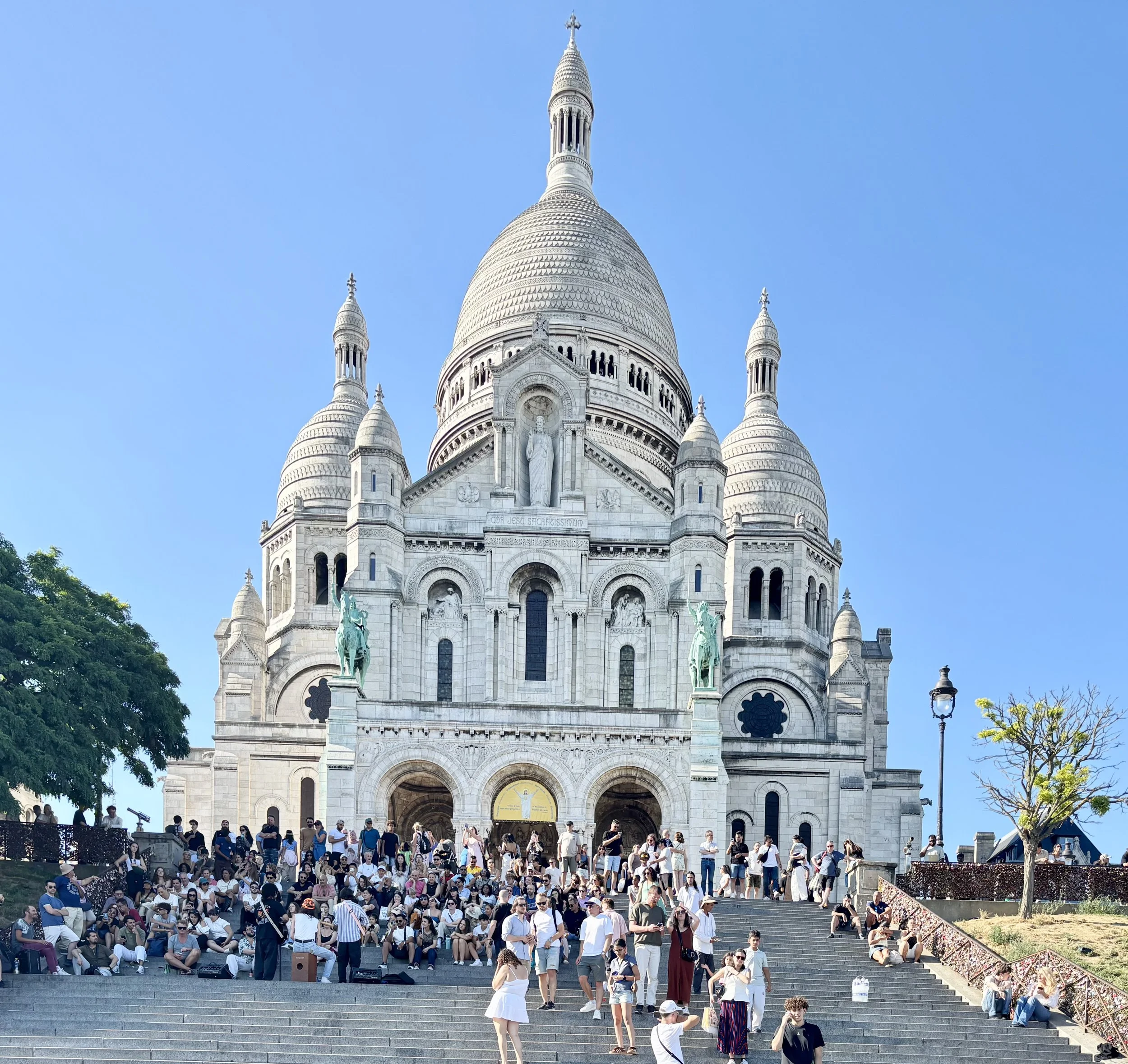
Basilique du Sacré-Cœur de Montmartre — Paris just below, and the weight of who you carry with you.
The Last Night
My last evening in Paris I went back to Montmartre. Dinner at the Moulin de la Galette — one of the oldest restaurants in the city, literally inside a windmill. Exactly as good as that sounds.
After dinner, I walked to Place du Tertre — the square where artists have been setting up their easels for over a century. I sat for a portrait. And then I had one done of my dog. Honestly one of my favorite moments of the whole trip. There's something about sitting still while a stranger studies your face — you see yourself from the outside for a minute. It's a small thing. It's not a small thing.
I left Paris with two portraits, a camera full of photos, new connections, and paintings that will be the first pieces The Archive ever offers.
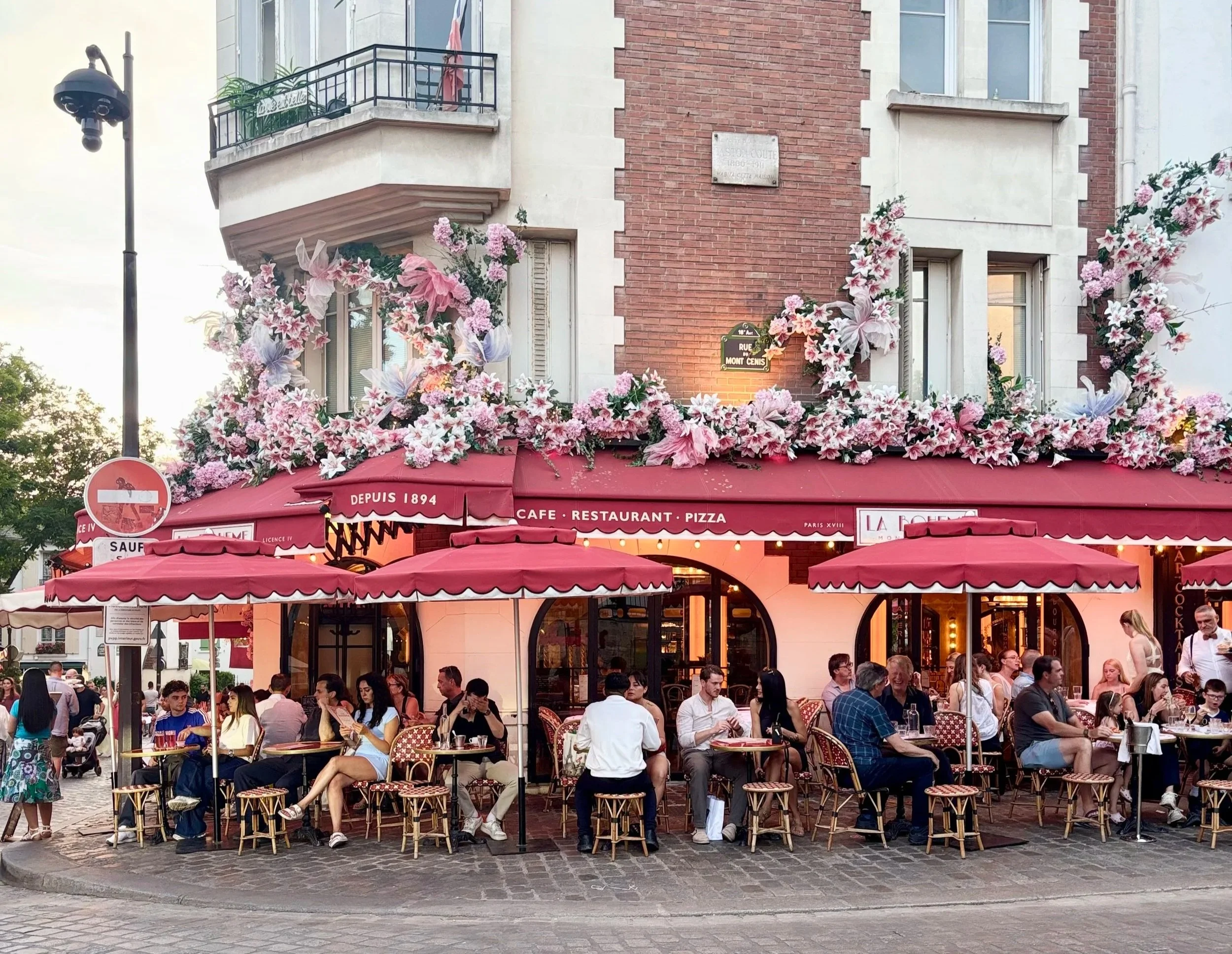
Place du Tertre, Montmartre — right across from the artists who have been setting up their easels here for over a century.
CHAPTER THREE
Provence &
the South of France
After London and Paris, the South of France was the first time I actually stopped.
I stayed in Villeneuve-Loubet, just outside Nice — Cannes and Antibes by train, the Mediterranean a short walk from the hotel. Days on the beach. Swimming in the Baie des Anges. An afternoon on a catamaran off the coast of Antibes, in open water, far enough from shore that everything went quiet. Nice on foot — the old town has this warm ochre color that looks almost too saturated to be real. Cannes, where the Carlton overlooks the beach like it has always known it would be looked at.
This part of the trip wasn't about sourcing or research or building anything. It was about remembering what it feels like to just be somewhere beautiful with nowhere to be. That's part of the work too.
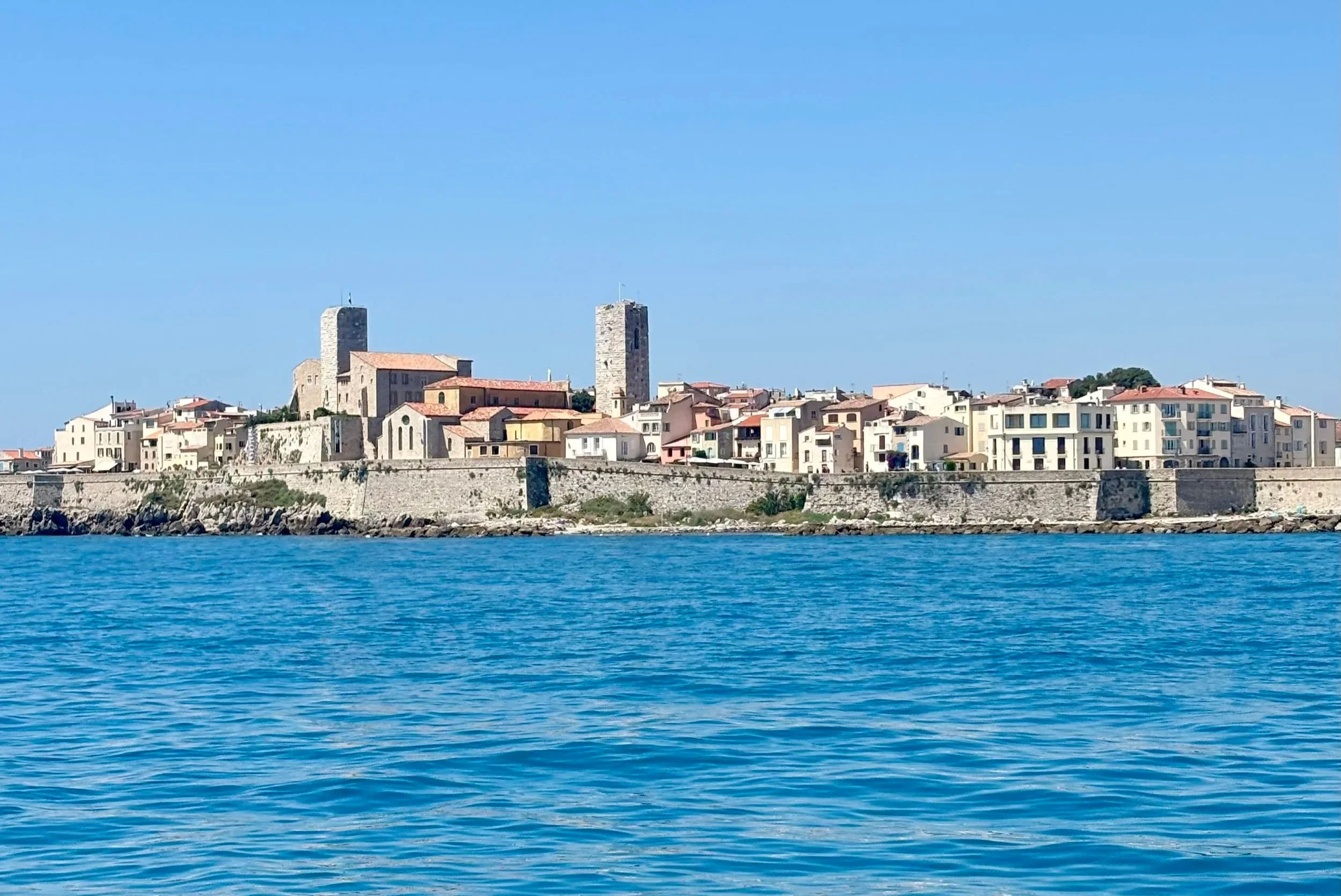
View of Antibes from The Baie des Anges — the Bay of Angels, which earns its name in the summer light.
Into Provence
From the coast we drove into Provence, and everything changed.
We smelled the lavender before we saw it. The scent just arrives on the wind before the fields even come into view. And then they open up — miles of it across the Valensole plateau, in rows so precise they look drawn. I've seen photographs of this my entire life. Nothing prepares you for the actual thing. The scale, the movement — lavender in the wind doesn't hold still, and a full field of it looks almost liquid. I stood in the middle of the rows. The bees were absolutely unbothered by me.
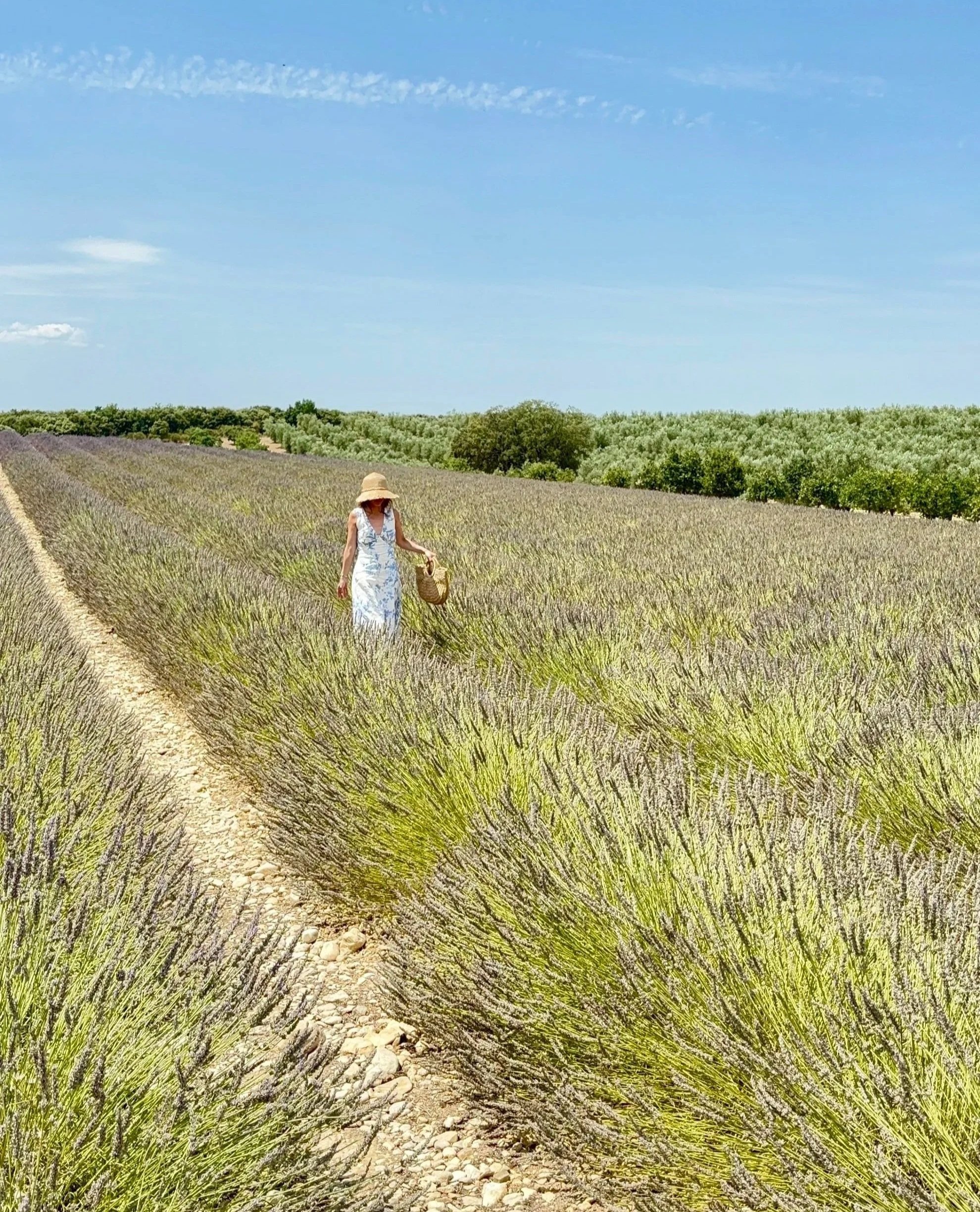
Valensole — where the scent arrives before the sight does.
Valensole
Valensole village is small, warm, and genuinely welcoming. We stopped for lunch and cold drinks on a very hot afternoon — ate well, wandered around, did some souvenir shopping. The kind of shopping that has nothing to do with curation and everything to do with wanting to take a piece of a place home. Lavender everything, ceramics in the Provençal palette, textiles in the colors of the fields. Nothing pretending to be from somewhere else.
Moustiers-Sainte-Marie
Moustiers-Sainte-Marie was not something I was prepared for.
The village literally clings to a cliff face — it's been there since the 5th century, when monks settled in the surrounding caves. Cobblestone streets, stone buildings, narrow roads winding up toward the chapel. And suspended between two rocky peaks above the village, on a long golden chain, a five-pointed star. A knight returning from the Crusades placed it there in gratitude to the Virgin Mary. Whether that's completely true or not — the star is there, and it is one of the most stunning things I've ever seen.
Moustiers is also the ceramics capital of Provence, with a faïence tradition going back to the 17th century. The shops along the cobblestone streets are incredible to walk through. I found pieces here for The Archive — ceramics with real provenance, made by artisans carrying a craft tradition that goes back centuries. When those pieces show up in the collection, I'll describe them exactly as what they are.
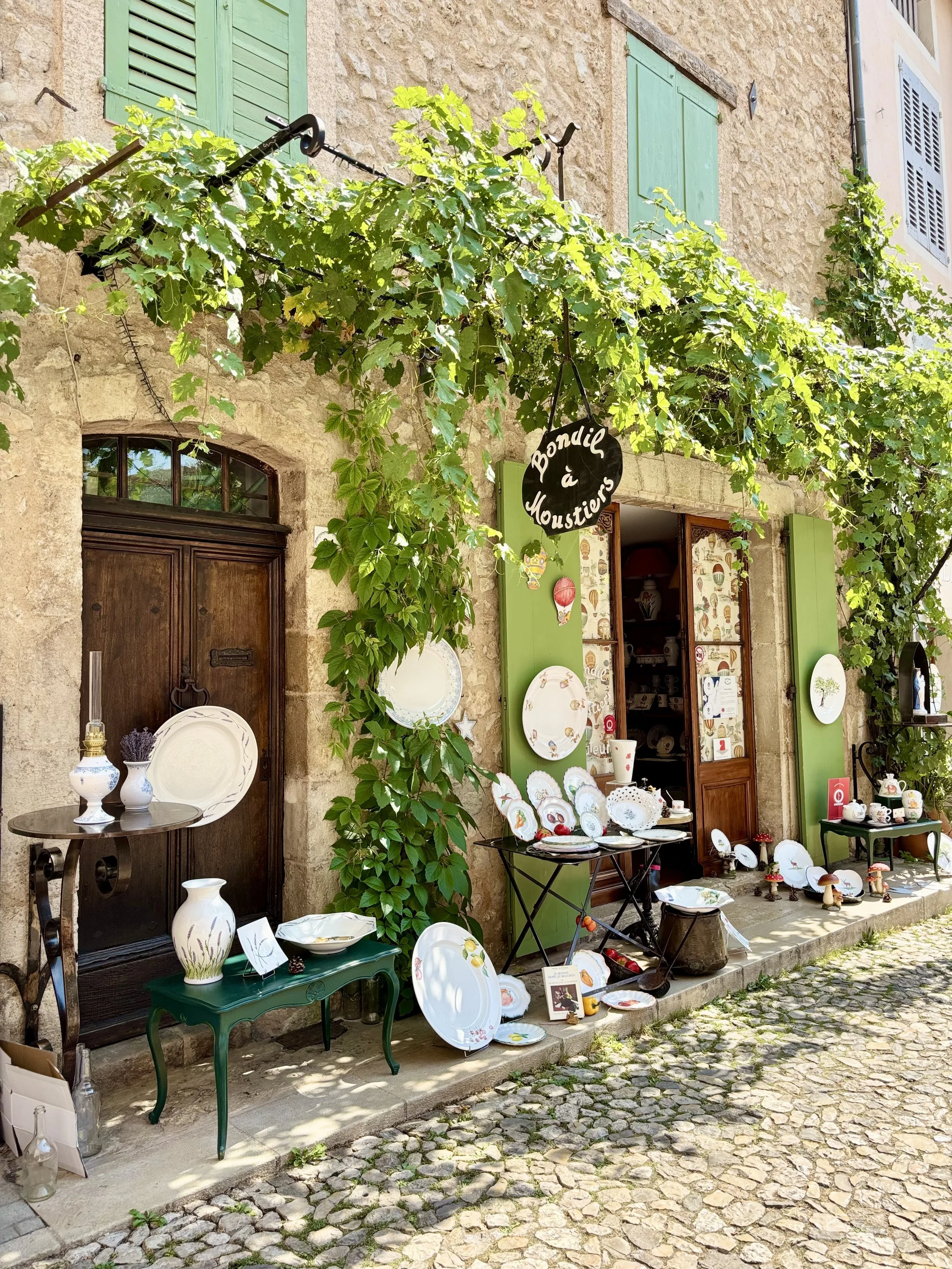
Moustiers-Sainte-Marie — clinging to a cliff face since the 5th century, and still exactly itself.
The Gorges du Verdon
The last part of the day was the Gorges du Verdon, driving through La Palud-sur-Verdon along the rim of the canyon. At intervals the land just drops away — hundreds of meters of sheer limestone cliff, and at the bottom the Verdon river running a turquoise so specific and vivid it looks like someone chose it on purpose. They didn't. That's just what happens when glacial meltwater moves through this particular limestone for thousands of years.
We drove slowly. You have to. We came out the other side a little exhausted in the way you get when you've taken in too much beautiful in one afternoon. That's the best kind of tired.
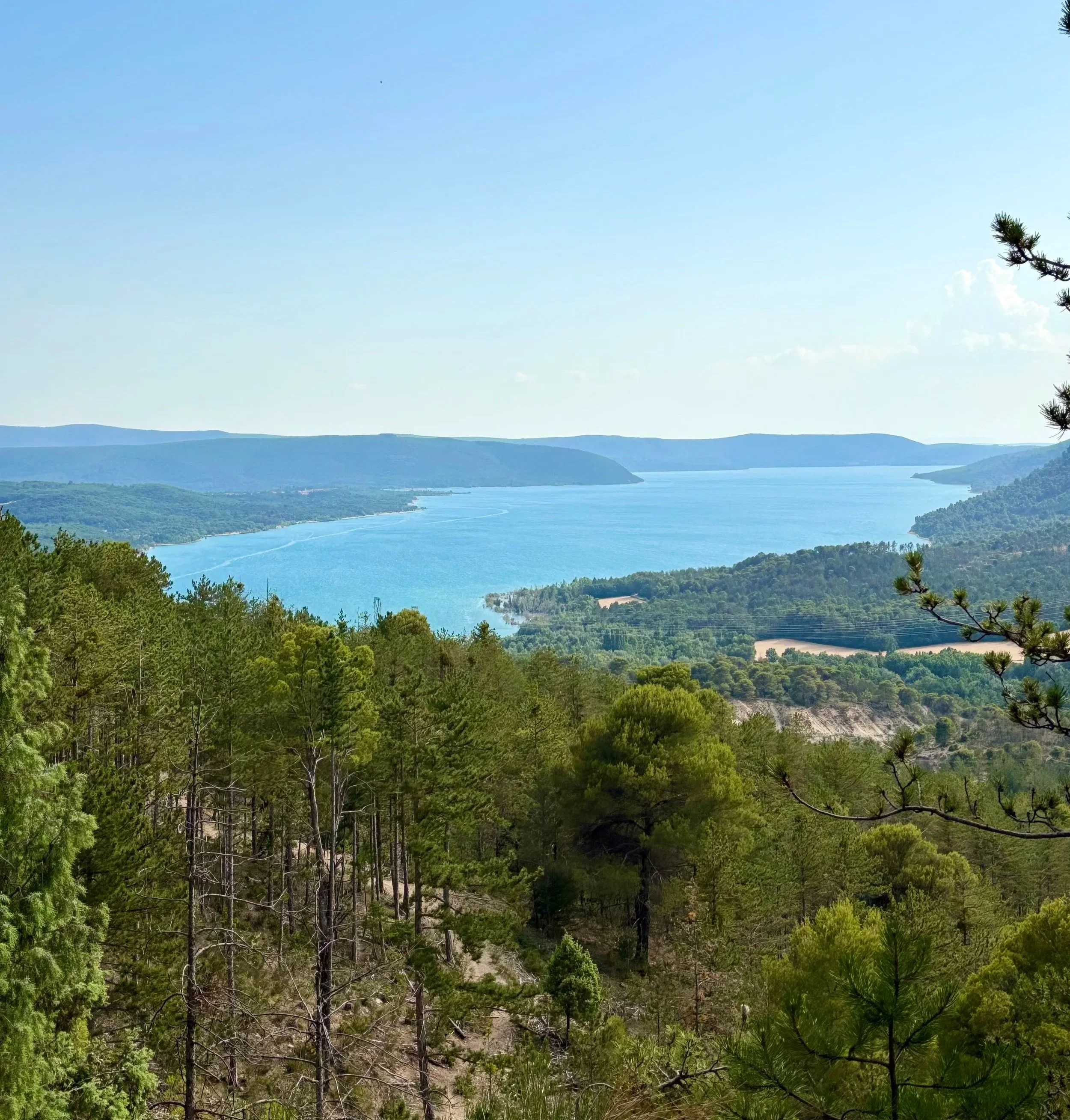
Gorges du Verdon — nature doing what design can only approximate.
CHAPTER FOUR
London,
the Return
I came back to London knowing it a little differently.
The first stay was about arriving and searching — everything new, everything to figure out. The second stay, based in Soho, was quieter. I wandered more. Had less of an agenda. That shift happens when you stop being a tourist somewhere and start feeling like a temporary resident.
The City from Every Angle
I did a day tour by double-decker and I genuinely recommend it to anyone who thinks they've already seen London. The city reads completely differently from the top of a bus. Westminster, Parliament Square, the Elizabeth Tower, the London Eye over the South Bank — all of it just makes more sense when you can see how it connects.
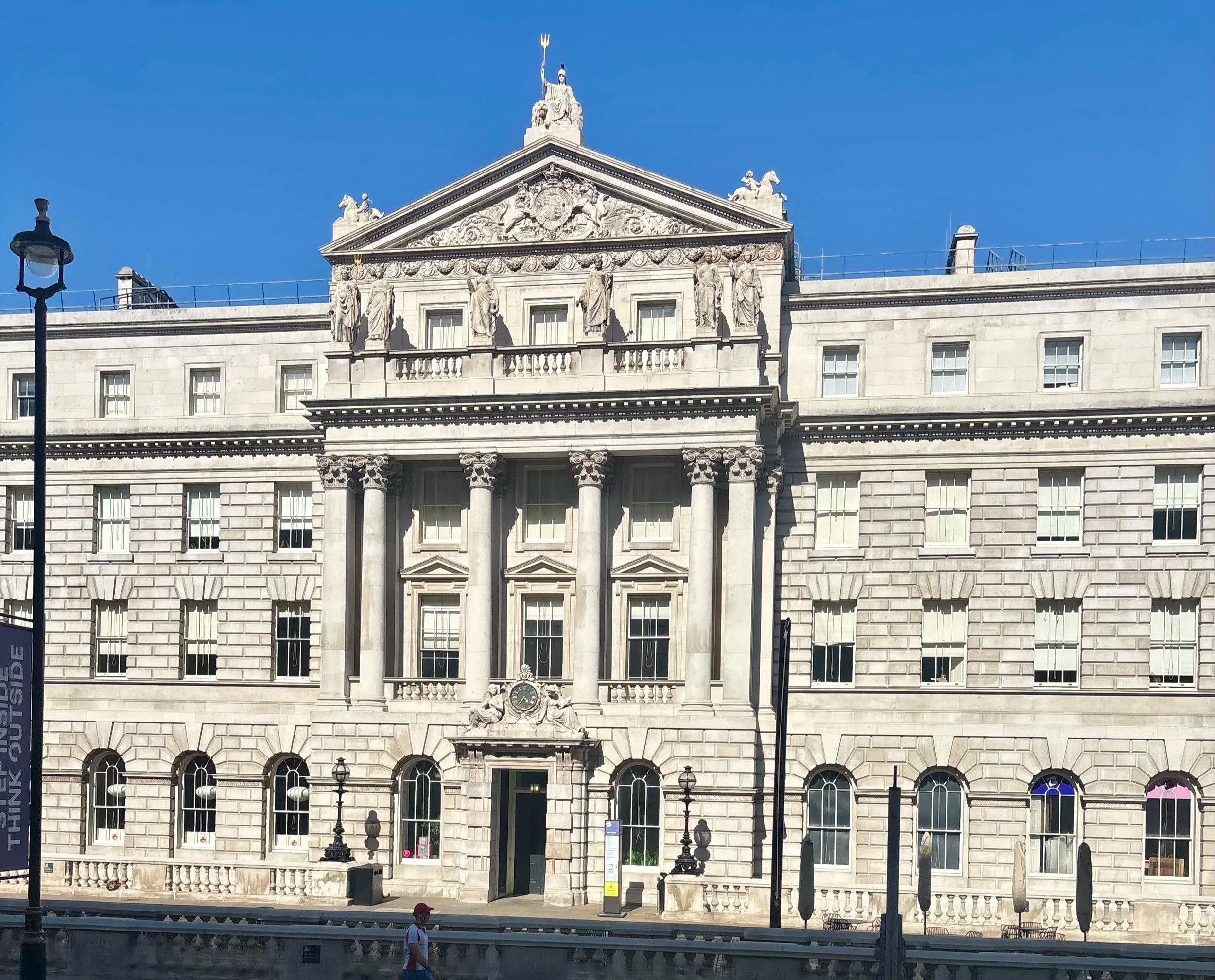
London from the top of a double-decker — where you stop seeing streets and start seeing systems.
The City & Kensington
What I noticed most on this second stay was how much London holds at once — and does it effortlessly.
Cream Victorian homes in Holland Park, quiet and elegant on leafy streets. The red brick of the Royal Albert Hall a short walk away — a completely different century in material and mood. Shoreditch's glass towers and murals. Georgian terraces next to modern developments. None of it matches, and somehow all of it belongs. London doesn't try to be one thing. The result feels alive in a way that more uniform cities don't.
The people are the same way. The diversity of London — the ease with which it holds so many different backgrounds and languages — reminded me of New York. It felt familiar. It felt like home.
Holland Park and Kensington became my favorite parts of the city. The cream Victorian homes, the garden squares, the proportions of the buildings. Beauty that doesn't announce itself.
And the flowers. London in summer is completely draped in them — hanging baskets from every pub and shop front, flower arrangements framing doorways, window boxes everywhere. Against the cream of Holland Park they land with real force. One accent in an otherwise restrained palette, and it makes you notice everything differently. I thought about that a lot as a design principle.
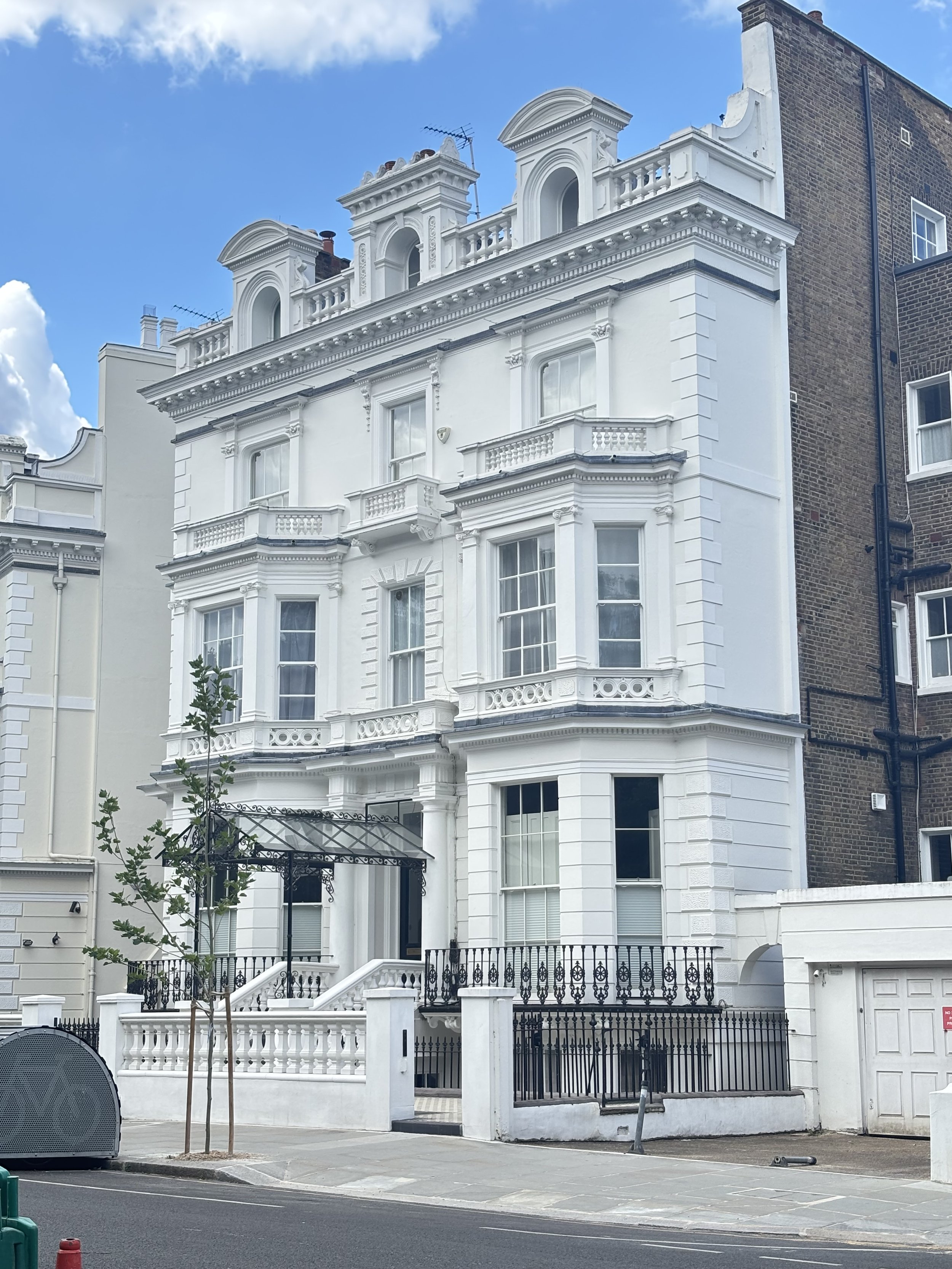
Holland Park, London — cream Victorian homes and leafy streets.
Westminster Abbey
I visited Westminster Abbey one morning and was not at all prepared for Poets' Corner.
It's the section of the Abbey where England memorializes its writers and poets — Chaucer, Dickens, Hardy, T.S. Eliot, Jane Austen's memorial stone. Name after name in the floor beneath your feet. You're literally walking on the graves of people whose words outlasted everything else about their time.
Standing there, I thought about The Archive. About what it means to choose something because it carries something worth preserving. Design, at its best, is also preservation.
Alfie's Antique Market
The best discovery of the second stay happened on my last day: Alfie's Antique Market.
Four floors of dealers, each with their own corner and their own specialty. Art, furniture, jewellery, ceramics, vintage fashion, objects you can't immediately categorize. I found original art I didn't expect to find. Made connections I wasn't planning to make. Left with a full bag and a list of contacts and a very strong intention to come back.
Alfie's is now on the permanent sourcing calendar.
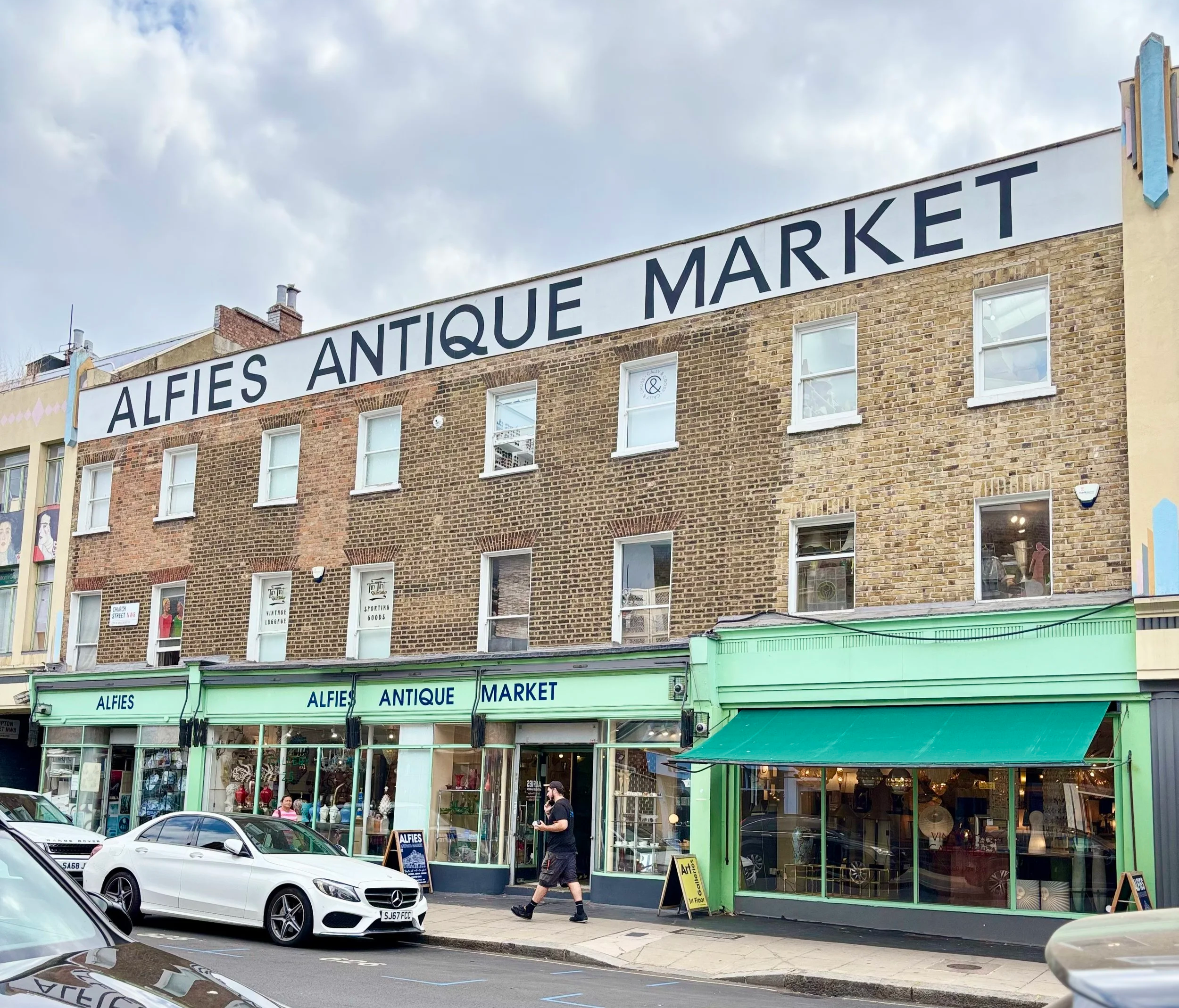
Alfie's Antique Market — Saved the best for last. The best kind of discovery.
The Pubs
In between all of it — there were the pubs.
England was still in the World Cup during my second stay, and London pubs during a major tournament are an experience. Pure collective hope and anxiety, strangers suddenly unified over 90 minutes of football happening somewhere far away.
I watched the semi-final against Argentina in a pub. England lost. We all left the pub feeling defeated, as if we had played that night. Then the streets started to fill up. People waving the British flag, standing on top of phone booths. Others singing Wonderwall. Then Hey Jude. — no one really in mourning, just in that very English way of reminding themselves there are things more durable than a football result.
I didn't expect that to be one of the most moving moments of the trip. It was.
Bath
My last full day in London was a day trip to Bath — and it was the perfect way to close the whole trip.
Bath is what happens when a city commits to one architectural vision and holds it for three hundred years. Georgian, from one end to the other. I arrived by train and immediately understood why Jane Austen wrote so much of her work here, why Bridgerton keeps coming back to film here. It just looks like that.
The Royal Crescent stopped me first — thirty terraced houses in a single sweeping curve. The longest unbroken Georgian facade in Britain. From the end of it, the curve just keeps going. It's almost theatrical.
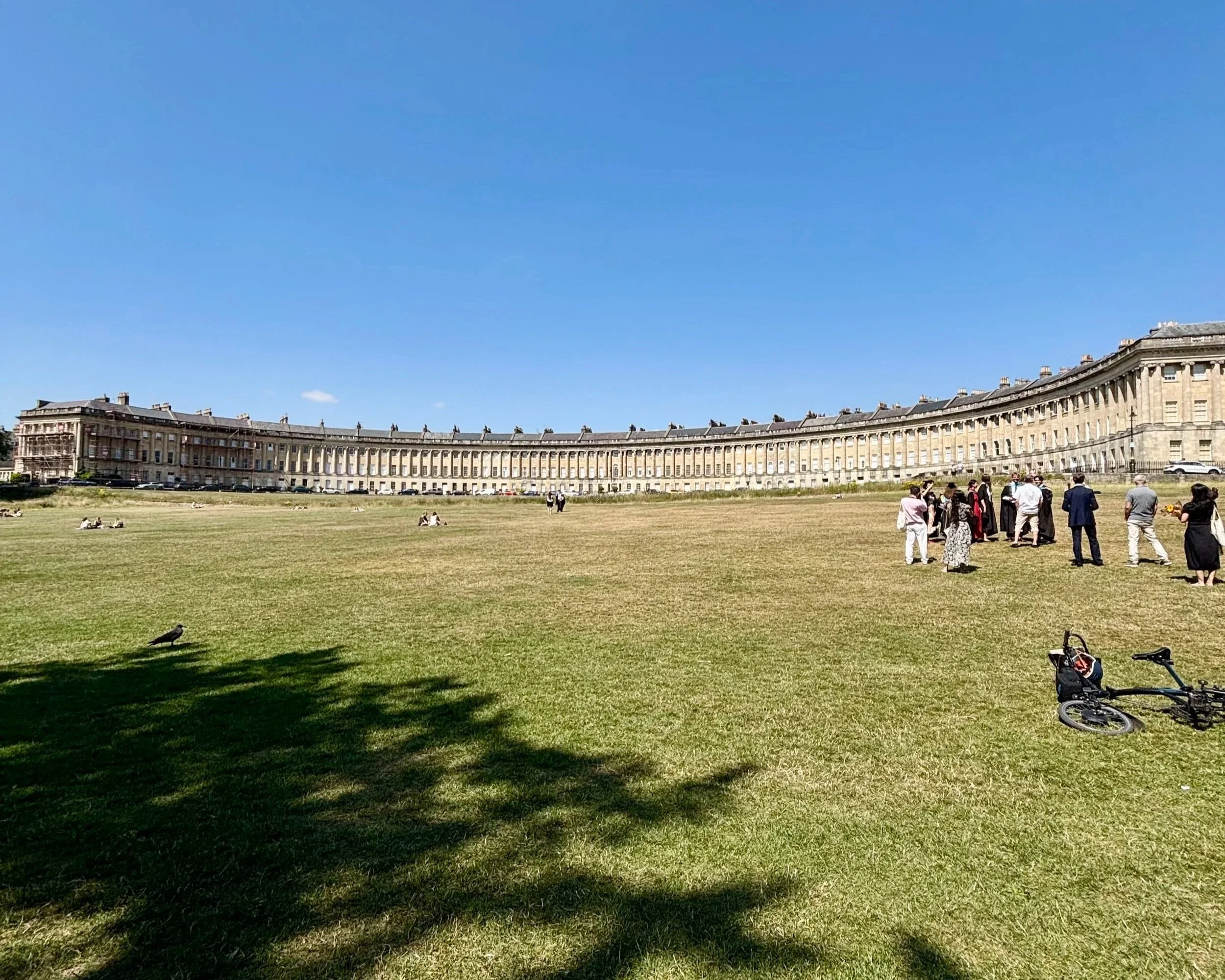
The Royal Crescent, Bath — thirty houses in a single sweep, built between 1767 and 1774.
The Circus. Pulteney Bridge. The Roman Baths — 2,000 years of history beneath a Georgian city, the thermal spring still running green and warm. The Jane Austen Museum on Gay Street. Sydney Gardens. And the Holburne Museum, which I walked up to as a cultural institution and recognized immediately as Lady Danbury's house from Bridgerton. I genuinely felt something.
Tea and Sally Lunn's buns before the train back. The oldest house in Bath, serving those buns since 1680. Worth it.

The Roman Baths, Bath — two thousand years beneath a Georgian city.
I left Bath already planning the return. One day was not enough — it never would be. But it was exactly the right way to end a trip that gave me more than I came looking for.
"Everything we see can bring inspiration for a space — even if we haven't met that space yet."
My home — the way I live in it, the way I design it — is a direct reflection of everywhere I've been. The textures I reach for, the colors I trust, the sense of proportion I bring to a room. All of it comes from standing in places that got it right and paying attention to why.
Travel doesn't just give you images to bring home. It changes how you see.
The Archive is being built carefully. The Paris paintings will be the first pieces — chosen not because they were available, but because they stopped me. The Moustiers ceramics will come with their full story attached. The Alfie's finds will be described exactly as what they are: discovered on the last afternoon, completely unplanned, with just enough time left to be surprised. Provenance isn't just about age. It's about how something came to be chosen. Every Archive piece will be described that way.
Twenty days in Europe produced not a haul, but a foundation. Contacts in London and Paris. A network of dealers. A clearer eye. And a handful of paintings and ceramics that will be the first things The Archive ever offers.
It was worth every step.
— Mel, Melrose Home & Co.
melrosehomeandco.com · @melrosehomeandco